

Is There an FAA-Approved Aircraft Detailing Certification? The Honest Answer
Short answer: No. The FAA does not issue, approve, or recognize any aircraft detailing certification — not ours, not anyone’s. There is no federal license for aircraft detailers, and no government agency accredits detailing training courses. Every certification in this industry, including the Shiny Jets certification, is a private credential issued by the company or association that ran the training.
If you’re researching aircraft detailing courses, you’ve probably seen programs advertised as “FAA-approved,” “officially recognized,” or even “the only recognized certification.” We run a certification program ourselves, so it might seem strange that we’re the ones telling you those claims don’t hold up. But you’re about to spend real money and build a career on this training. You deserve the truth first.
Here’s what the regulations actually say, what “certified” really means in this industry, and how to judge a course on the things that matter.
What the FAA actually certifies
The FAA certificates people and organizations whose work directly affects airworthiness:
- Pilots — under 14 CFR Part 61
- Mechanics and repairmen — under Part 65
- Repair stations — under Part 145
- Aviation maintenance technician schools — under Part 147
Notice what’s not on that list: aircraft detailers. There is no FAA certificate category for detailing, and no approval pathway a detailing school could even apply for. Part 147 approval exists for schools that train A&P mechanics — not for courses that teach washing, polishing, and coating.
Routine washing and cleaning isn’t even “maintenance” under the regulations — it’s servicing. You do not need an FAA certificate of any kind to wash an airplane.
So when a course claims to be “FAA-approved,” ask one question: approved under what? There is no mechanism in the federal regulations that produces an FAA-approved detailing certification.
Is aircraft detailing certification required by law?
No federal law or FAA regulation requires a certification to detail aircraft. Nobody is checking for a detailing license, because none exists.
But “required” has a second, very real meaning in this business. Try getting on the ramp at a busy FBO without it:
- FBOs and flight departments commonly require vendors to carry proof of insurance, and many want evidence of formal training before you touch a customer’s jet.
- Insurance carriers want to know what qualifies you to work around multi-million-dollar aircraft when they price your policy.
- Airport access is controlled. At most fields you’ll need badging or an escort, and at commercial airports that means background checks.
- Owners and chief pilots want a reason to trust you before you put a buffer anywhere near their paint.
That’s the honest role of certification in this industry: it isn’t a government requirement — it’s how you clear the practical gatekeepers, and, if the training behind it is real, how you avoid the mistakes that end careers.
Where detailing does touch federal regulations
Here’s the part most course marketing skips, and it’s the strongest argument for real training.
Basic cleaning is unregulated. But some tasks at the edges of detailing appear on the FAA’s preventive maintenance list in Part 43, Appendix A — things like refinishing decorative coatings and applying preservative or protective materials where no disassembly is involved. Preventive maintenance carries its own rules about who may perform it and how it gets recorded. A professional detailer needs to know where cosmetic work ends and regulated maintenance begins — and when the right answer is “hand this to an A&P.”
A few more places where the stakes are federal, not cosmetic:
- Balanced control surfaces. Even the FAA’s refinishing allowances exclude them, because adding or removing material changes their balance. This is not a place to freelance.
- Pitot tubes, static ports, and sensors. Covering them before a wash — and verifying every cover comes off afterward — is airworthiness discipline. A blocked static port is a flight-instrument problem, not a cosmetic one.
- Manufacturer guidance. Airframe manufacturers publish cleaning procedures and chemical guidance in their maintenance documentation, and reputable aviation chemicals are tested to industry specifications like Boeing D6-17487 and SAE AMS 1526. Some manual items are hard requirements; many are recommendations that leave room for professional judgment. Knowing which is which is part of the craft.

None of this makes any detailer a government-certified anything. It’s simply why the training behind a certificate matters far more than the certificate itself.
What “certified aircraft detailer” actually means
A detailing certification means one thing: a private company or association trained you and is willing to put its name behind your work. That’s it — and that’s not nothing.
The value of the credential is exactly equal to the value of the training and the reputation of the people who signed it. A certificate earned through station-by-station skill verification on a real business jet and a certificate handed out for sitting through a weekend of slides look identical in a picture frame. The aircraft owner writing the check can’t always tell the difference on paper — which is precisely why some programs reach for official-sounding claims instead of substance.

Red flags when comparing aircraft detailing courses
Put these questions to any program you’re considering — including ours:
- “FAA-approved” or “FAA-certified” claims. No such approval exists for detailing courses. A program making this claim either doesn’t understand the regulations it operates under, or hopes you don’t. Neither is a good trait in an instructor.
- “The only recognized certification.” Recognized by whom? No government body — and no single industry authority — has the standing to grant exclusive recognition. When no recognizing authority exists, exclusivity claims are marketing, nothing more.
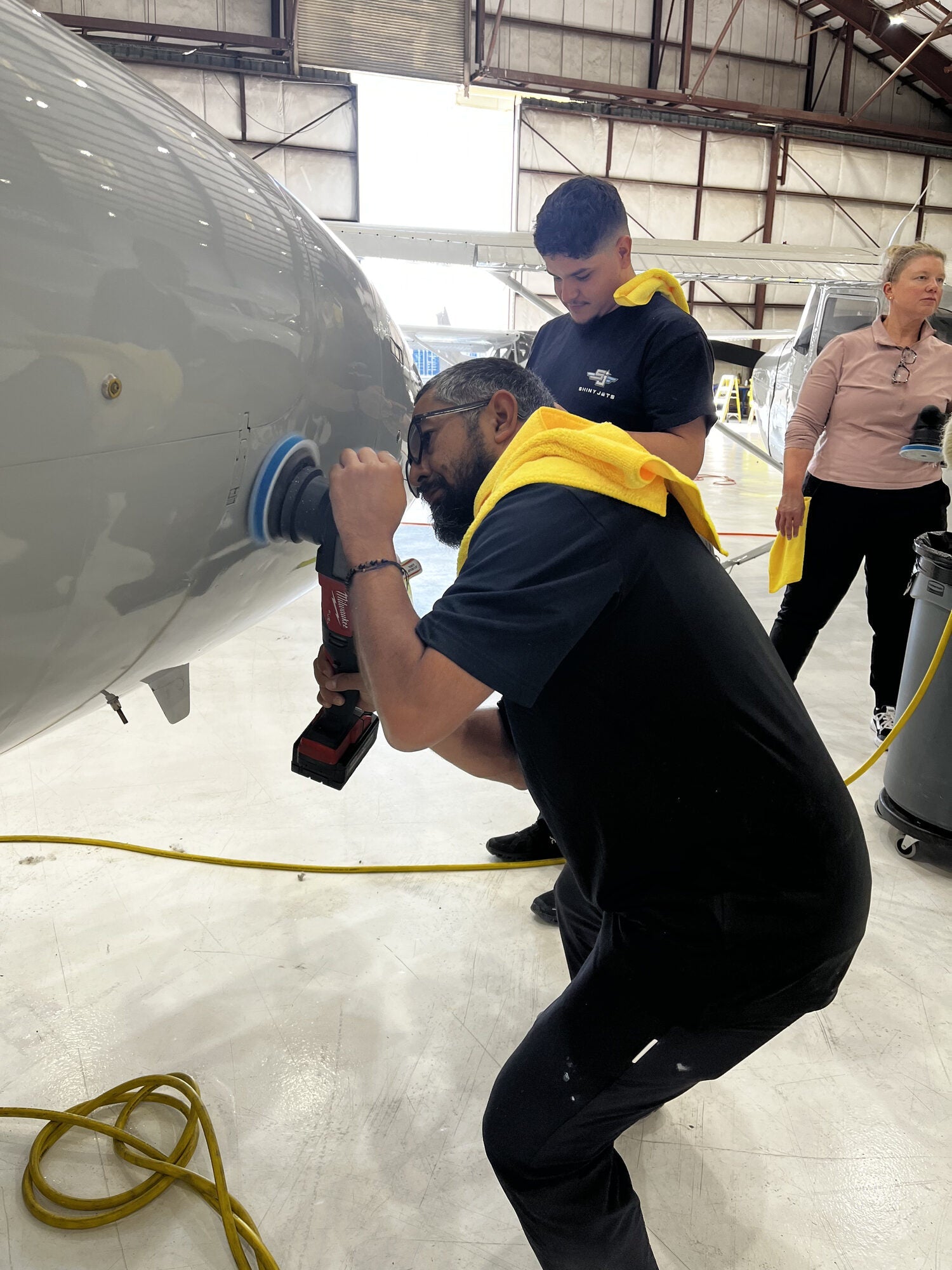
- No real aircraft in the training. If the course photos show cars, or no aircraft at all, you will not be ready for a Gulfstream.
- No connection to manufacturer documentation. If a program can’t explain how its procedures relate to manufacturer cleaning guidance and aviation chemical specifications, its procedures are opinions.
- Certificates for attendance. Ask what you must demonstrate — and what happens if you can’t — before the certificate is issued. If the answers are “nothing” and “nothing,” that’s what the certificate is worth.
What to look for instead
- Hands-on hours on real aircraft, at a real airport, under supervision
- An instructor with a track record you can verify — years in the industry, work you can see, material they’ve published
- Procedures grounded in manufacturer guidance and aviation-grade chemical specifications, with honesty about what’s required versus what’s recommended
- A real safety curriculum: sensor and port protection, FOD awareness, ladder and fall discipline around aircraft
- Skill verification before certification — a certificate you earn, not receive
- Business support after the certificate: insurance guidance, pricing, and how to land FBO and owner clients, because most students are building a business, not just a skill set

The bottom line
There is no FAA-approved, government-recognized aircraft detailing certification in the United States — from anyone. Any program that told you otherwise told you something untrue before you ever paid them, and that should weigh heavily in your decision. Choose a course the way an aircraft owner chooses a detailer: on verifiable experience, real procedures, and work you can inspect. And if you’re at the start of that road, our guide on how to become a certified aircraft detailer walks the whole path.
Frequently asked questions
Is aircraft detailing certification required by law?
No. No federal law or FAA regulation requires certification to detail aircraft. In practice, FBOs, flight departments, and insurers often require proof of training and insurance before you can work — that’s a business requirement, not a legal one.
Does the FAA license or approve aircraft detailers?
No. The FAA certificates pilots, mechanics, repair stations, and maintenance technician schools. There is no certificate category for aircraft detailers and no approval pathway for detailing courses.
Can anyone legally wash an airplane?
Washing and routine cleaning are considered servicing, not maintenance, so no FAA certificate is required. Some tasks at the edges of detailing — like refinishing decorative coatings or applying preservative materials — fall under the FAA’s preventive maintenance rules, which is one reason proper training matters.
Are aircraft detailing certifications worthless, then?
No. They’re private credentials, and a good one signals real, verified training — which is exactly what FBOs, insurers, and aircraft owners are screening for. The credential is worth whatever the training behind it is worth.
Is any course “the only recognized aircraft detailing certification”?
No. Because no government body or single industry authority recognizes detailing certifications at all, no program can truthfully claim to be the only recognized one.
About Shiny Jets: Shiny Jets trains aircraft detailers on real business jets at Chino Airport (CNO) in Southern California, with station-by-station skill verification before any certificate is issued. The program was built by founder Brett Berry over 15+ years of hands-on aircraft detailing — the same experience behind his book Beyond Shiny. Our certification is a private credential, just like everyone else’s. The difference is we’ll tell you that — and then show you the training that makes it worth holding.

Explore the aircraft detailing certification program, see the hands-on courses at Chino Airport or the self-paced online masterclass, or book a free call and we’ll help you find the right path — even if it isn’t with us.

De Brett Berry


Dejar un comentario
Este sitio está protegido por hCaptcha y se aplican la Política de privacidad de hCaptcha y los Términos del servicio.