

Every Shiny Jets Aircraft Detailing Training Comes With a Full Library of Standard Operating Procedures
You don't have to remember everything. You take it home with you.
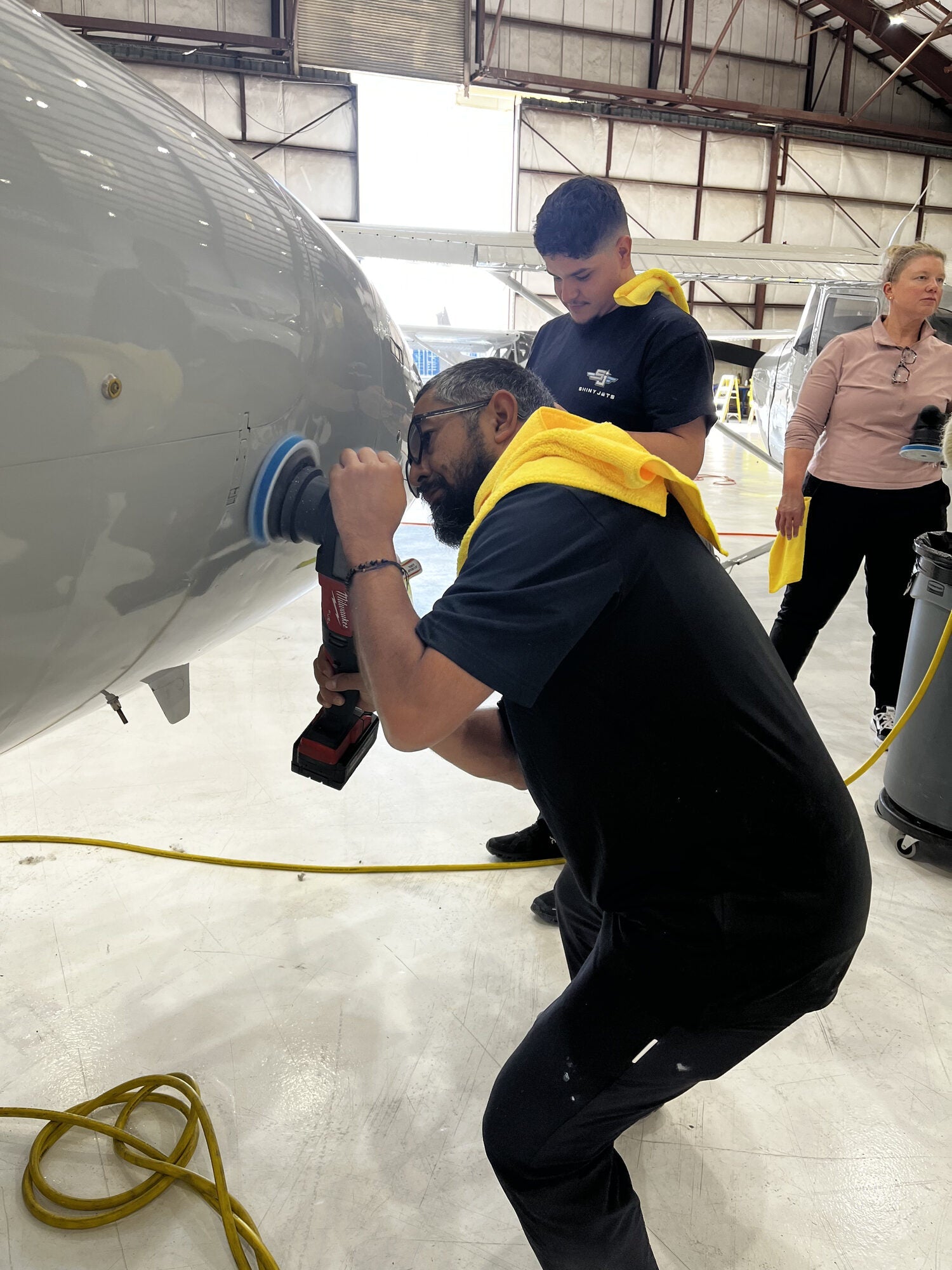
One of the most common things I hear from students after a Shiny Jets aircraft detailing training is some version of: "That was a lot." Five days at Threshold Aviation at Chino Airport, hands-on with real jets, working through everything from a dry wash on a Citation to wet-sanding an unpressurized window. By the end, you've seen it all. But you've also seen a lot. Nobody remembers every step of every service on the flight home.
That's why every Shiny Jets aircraft detailing training comes with the complete Shiny Jets SOP library — the same standard operating procedures we use in the field every day. Students take them home as PDFs, printed in a binder for the work hangar, and accessible from their phone when they're standing in front of an aircraft trying to remember which compound goes with which pad.
Below is what's actually in the library, why we built it, and how students use it after they leave Chino.
What is an Aircraft Detailing SOP and Why Does It Matter?
A Standard Operating Procedure is a step-by-step document covering one specific service: dry wash, leather cleaning, paint restoration, de-ice boot restoration, and so on. It tells you the products, the tools, the order of operations, the safety rules, what to document in the Shiny Jets CRM before and after the service, and the critical "don'ts" — the mistakes that cost customers money.
A good SOP isn't a PowerPoint. It's a checklist you can run while you're working. It's what separates a professional aircraft detailing service from someone with a bucket and a hope.
In aviation detailing the stakes are different than auto detailing. A de-ice boot is flight safety equipment. A polished aluminum leading edge is a paint thickness that you only get to cut so many times in the life of the airframe. A wool cabin carpet might be custom-dyed and irreplaceable on a discontinued aircraft. The SOP exists so you don't guess.
What Standard Operating Procedures Are Included With Shiny Jets Training?(Make sure its included in your training as not all trainings get all the SOP's)
Every student who completes a Shiny Jets aircraft detailing course leaves with the following SOPs:
SOP #1 — Dry Wash. The most common service in modern aviation detailing. Order of operations on pistons and jets, painted leading edge protocol, polished aluminum handling, de-ice boot handling during a wash.
SOP #2 — Interior Maintenance Cleaning. Cockpit, cabin, lavatory protocol. Dust before wiping. Phase one (hard surfaces) and phase two (vacuuming) workflow. The flow through the aircraft so you don't backtrack.
SOP #3 — Leather Cleaning. Light, standard, and stain-specific procedures. Seat belt cleaning per FAA AC 43.13-1B and the AmSafe / TSO-C22 guidelines. Suede, micro suede, and Alcantara handling.
SOP #4 — Carpet Cleaning. Wool-first protocol. pH and PPM measurement at every stage. UV stain scan. Stain diagnosis by pH reading. Bridgepoint product chart. Mandatory thermal verification of drying.
SOP #5 — Decontaminate Paint. Top surfaces only. Bag test for fallout. Clay bar handling. Why decon doesn't go before paint restoration, and what masking is actually needed.
SOP #6 — Paint Restoration. Single-stage versus clearcoat decision matrix. The step-back principle. How to add cut without adding pressure. Edge and rivet burn risk. Alcohol-wipe inspection.
SOP #7 — De-Ice Boot Restoration & Maintenance. Goodrich and PBS product lines side by side. The boot prep strip procedure. Conductive cement masking. Why you don't lift a vortex generator. ICEX II as the ice retarder.
SOP #8 — Paint Protection. Five-tier ladder from 3D HD Speed up through Fly Shiny Pro ceramic coating. Hand-applied versus machine-applied ceramic technique.
SOP #9 — Cabinetry Veneer Polishing. Heat management as the controlling constraint. ACA 500 on wool then Fly Shiny Pro Polish on foam. Thermal camera monitoring. Rupes 3-inch and Nano iBrid for tight areas.
SOP #10 — Unpressurized Window Polishing. Test polish first. Wet sanding with 1000 then 2000 grit. ACA 500 then ACA 520. Edge work with the 3-inch DA. The rule: whatever you do to one part of the window, you do to the whole window.
SOP #11 — Brightwork Polishing. The four-tool aggressiveness ladder — Ryobi 10-inch random orbital, dual-action polisher, pneumatic drum buffer, Milwaukee rotary. Hard versus soft aluminum stepping logic. The full product and pad combination matrix for every tool.
That's eleven services. Roughly one hundred pages of detail. And it's all yours.
How Do Aircraft Detailing Students Use the SOPs After Training?
The SOPs aren't just a reference binder you put on a shelf. Here's how students actually use them after the training:
At the start of a new service type. Nobody does every service every week. A small operator might not see a de-ice boot restoration for six months. When the job comes in, the SOP gets pulled up so the procedure is fresh — no winging it, no calling someone on the phone trying to remember which prep comes before which sealant.
To train their own staff. A lot of our students go on to hire and train their own detailers. The SOPs become the curriculum. They hand a new hire the Dry Wash SOP and have them work through it with supervision. The next service, the new hire knows what they're doing.
To impress customers and aircraft owners. When a flight department or owner sees a detailer pull out a documented standard operating procedure that references FAA guidance, manufacturer specifications, and a clear pre-service / post-service CRM photo workflow, the perception changes. This isn't a kid with a sponge. This is a professional service.
As CRM workflow integration. Every SOP references the Shiny Jets CRM at the pre-service walkaround (upload photos, document existing damage, confirm warranty status) and at post-service QC (upload matching photos, document products used, mark complete). The CRM and the SOPs work together. Students who run on the Shiny Jets CRM have the workflow baked in.
When something goes wrong. Every SOP has a "Critical Don'ts" section at the end. That's hard-earned. Every one of those don'ts comes from a job that went sideways. When students hit a problem in the field, the Critical Don'ts are usually where the answer lives.
What is Included in the Shiny Jets 5-Day Aircraft Detailing Masterclass?
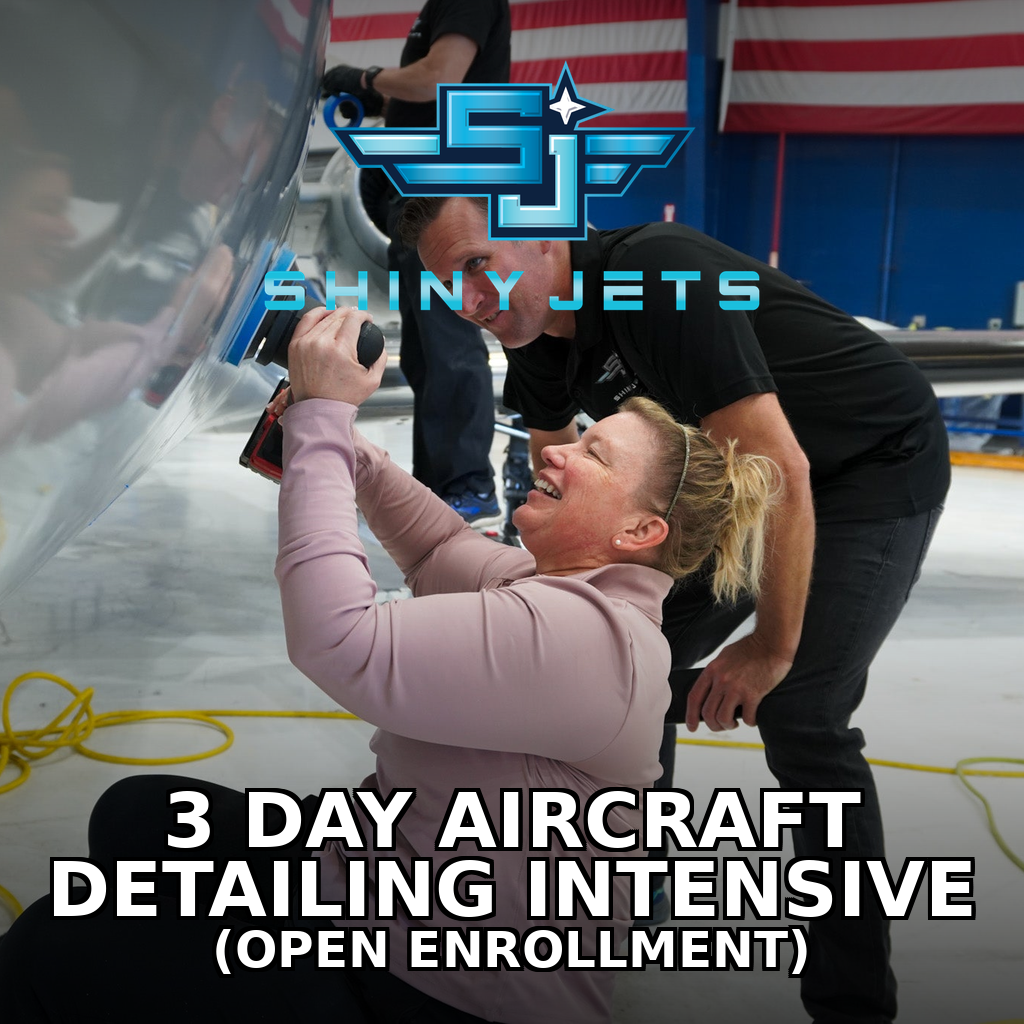
The five-day Aircraft Detailing Masterclass at Chino Airport covers every service in the SOP library, hands-on, with the instructor working alongside students on real aircraft. By the end of the week students have run a dry wash, decontaminated paint, restored paint, polished brightwork, sealed de-ice boots, cleaned wool carpet with full pH and PPM verification, and polished an acrylic window.
Then they leave with the SOP library so they don't have to remember it all from memory.
What is Included in the 3-Day Aircraft Detailing Certification?
The three-day Aircraft Detailing Certification is a more focused version of the masterclass, designed for working detailers who need core services nailed down fast. Same hands-on approach. Smaller SOP library at the end.
Is Aircraft Detailing Training Worth It?
Here's the math: a single mistake on a customer aircraft — a burned clearcoat from a rotary pad held too long, a wool carpet left at pH 8.5 that browns within forty-eight hours, a de-ice boot ruined by the wrong chemistry, a lifted vortex generator on a Citation Mustang — costs more than the entire price of the training. Sometimes by ten times. Sometimes more.
The SOPs are insurance. The training gets you fluent in them. After the course you have written, documented procedures that match what working detailers at the highest level of the industry actually do.
Where is Shiny Jets Aircraft Detailing Training Located?
The Shiny Jets training academy is based at Threshold Aviation, 7000 Merrill Avenue, Chino Airport (KCNO), Chino, California. Chino is one of the busiest general aviation airports in the western United States and we run training inside hangars with active aircraft. Students aren't practicing on a beat-up project. They're working on customer airplanes, supervised, with the same standards we run our service business on.
Frequently Asked Questions
Do aircraft detailing trainings usually come with written standard operating procedures?
Most don't. Most aviation detailing courses are taught from PowerPoint or a printed handbook that gets glanced at once and forgotten. Shiny Jets is one of the few programs that gives students the actual working SOPs the company runs on, as PDFs, ready to reference.
Can I use the Shiny Jets SOPs to train my own staff after the course?
Yes. That's part of why they exist in this format. You can hand a new hire the Dry Wash SOP, the Interior Maintenance SOP, the Leather Cleaning SOP, and have them work through one service at a time with supervision.
Are the SOPs updated when products or techniques change?
Yes. The Carpet Cleaning SOP, for example, was recently updated with a new wool pH and PPM protocol. Students who completed earlier courses get the updated version. The SOP library is living documentation.
Do the SOPs reference FAA and manufacturer guidance?
Where it matters, yes. The Leather Cleaning SOP cites FAA AC 43.13-1B and AmSafe TSO-C22 for seat belt handling. The De-Ice Boot SOP differentiates Goodrich-warrantied aircraft from out-of-warranty PBS-compatible aircraft. The SOPs aren't a substitute for a maintenance manual but they don't ignore the regulatory layer either.
What's the difference between the Shiny Jets SOPs and what you can find online?
What you find online is mostly auto detailing technique with the word "aircraft" sprinkled in. The Shiny Jets SOPs are built from fifteen-plus years of working on jets, turboprops, helicopters, and piston aircraft at Chino Airport. They cover the things aviation actually needs — de-ice boots, painted leading edges, polished aluminum brightwork, unpressurized windows, wool cabin carpet — that auto detailing content doesn't address.
Do I have to be running the Shiny Jets CRM to use the SOPs?
No. The CRM integration is built into the SOPs because that's how we run, but the actual cleaning, polishing, and restoration procedures stand on their own. The CRM steps can be adapted to whatever job-tracking system you use.
Can I see what an SOP looks like before signing up for training?
We're happy to show you. Reach out through shinyjets.com or call 619-438-4972 and we'll walk you through one.
Ready to Train at Shiny Jets?
Aircraft detailing is one of the few skilled trades where you can build a real business with the right training, the right systems, and the right reputation. The Shiny Jets approach is documentation-first: written procedures, photographed workflow, customer-facing professionalism that holds up next to flight departments and OEM dealerships.
If you're ready to learn aviation detailing at the highest level, with a complete library of standard operating procedures you take home and use for the rest of your career, the next course at Chino Airport is open for enrollment.
Visit shinyjets.com to see upcoming dates or call 858-267-4469 to talk through which course is right for you.
Shiny Jets — Aircraft Detailing Training Academy at Threshold Aviation, Chino Airport (KCNO), Southern California.

Written by Brett Berry

Leave a comment
This site is protected by hCaptcha and the hCaptcha Privacy Policy and Terms of Service apply.