

Kodiak 900 Paint Correction: What Aircraft Paint Looks Like After Orange Peel Removal
Updated October 2026 · By Brett Berry, founder of Shiny Jets
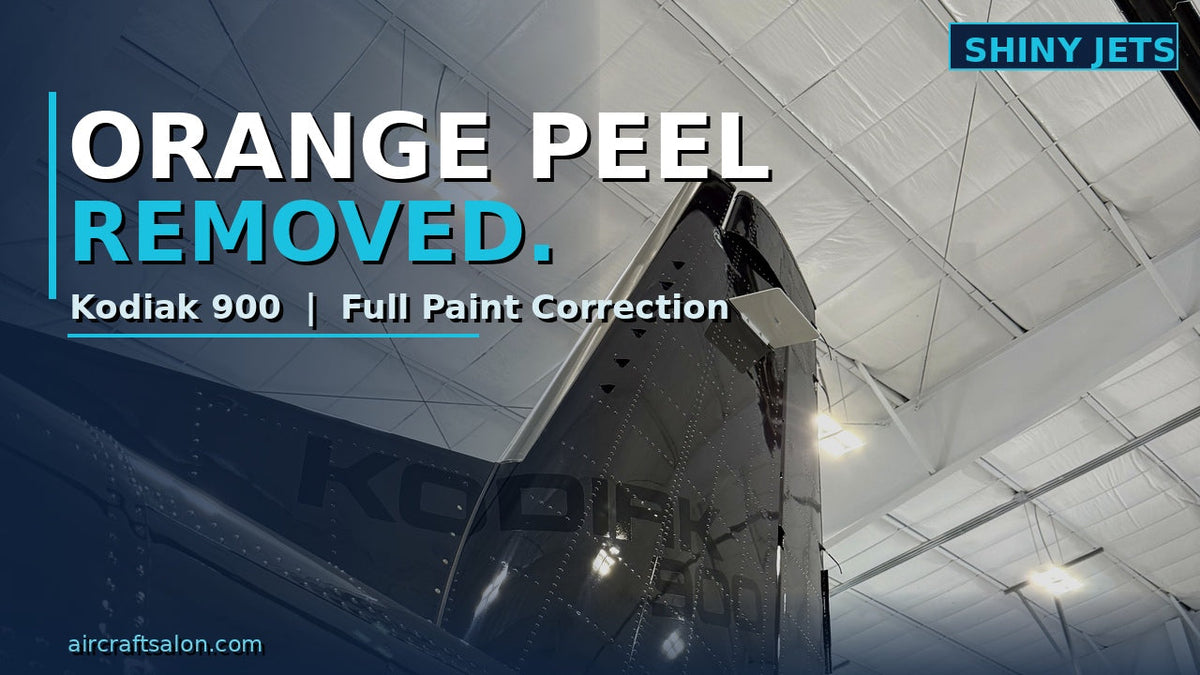
Orange peel removal on this Kodiak 900 turned deep gloss black paint into a flat, mirror-like finish. The aircraft was decontaminated, inspected under raking light, wet sanded, compounded, polished and finished before any protection was applied. A full correction on a Kodiak 900 typically takes two to three days, depending on paint condition and how many stages are needed.
Most aircraft owners have never seen what their paint is actually capable of looking like. What rolls out of the factory, even on a brand-new turboprop, is not the finished product. It's a starting point. This Kodiak 900 shows what's possible when you remove the orange peel and correct the surface properly.
Kodiak 900 project facts
| Aircraft | Kodiak 900 single-engine turboprop |
|---|---|
| Paint | Deep gloss black |
| Service | Full paint correction with orange peel removal |
| Stages | Decontamination wash and clay, raking-light inspection, wet sanding, compounding, polishing, final finishing, panel wipe and optical inspection |
| Typical time | Two to three days for a full correction on a Kodiak 900, depending on paint condition and stages needed |
| Documentation | Orange peel and gloss measurements were not recorded for this job, so it is not a documented Verified Finish |
What is orange peel in aircraft paint?
Orange peel is a texture defect in the clear coat or topcoat of an aircraft's paint system. Under raking light or a paint inspection lamp, the surface looks bumpy, like the skin of an orange. It's caused by how the paint atomizes and lands during spraying: the solvent flashes off before the paint fully levels, leaving microscopic peaks and valleys across the entire surface.
Every production aircraft has it. Piston singles, turboprops and light jets all leave the paint shop with some orange peel. Most owners never know it's there until they see a properly corrected finish side by side.
Orange peel is not a flaw you can polish away with a random orbital and a finishing compound. Removing it takes a structured, multi-stage paint correction: leveling the surface with an abrasive to cut the peaks, then refining through progressively finer stages until the surface is optically flat and gloss is maximized.
Why was the Kodiak 900 a challenging canvas?
The Kodiak 900 is a high-performance single-engine turboprop built for utility and reliability. It's not usually thought of as a luxury aircraft, but the owners who fly them care deeply about how they're maintained, and many Kodiak operators keep their aircraft in exceptional cosmetic condition.
Dark paint on any aircraft is unforgiving. Swirls, haze and surface texture are far more visible on black than on white. This Kodiak was finished in deep gloss black, so every imperfection in the paint showed under hangar lighting.
That also makes the result of a proper correction more dramatic. When you remove the orange peel from black paint and bring it to high gloss, you get a finish that reflects like a mirror: every light source, every rivet line, every contour of the aircraft.
What paint correction process did we use?
This was not a standard detail. A standard aircraft detail is washing, a light polish, and wax or sealant. What we did on this Kodiak 900 is a full paint correction, which physically removes defects from the clear coat instead of filling or masking them.
The job went through the same wet sanding, compounding, polishing and finishing stages as a Verified Finish. What it did not include was the measurement documentation, meaning the orange peel readings and gloss data that go into a Verified Finish record.
The correction stages on this aircraft:
- Full decontamination wash and clay bar treatment to remove embedded contamination before any abrasive contact
- Surface inspection under high-intensity raking light to map orange peel severity across panels
- Wet sanding to level the orange peel
- Compounding to remove sanding marks, using a rotary or dual-action polisher depending on panel geometry
- Polishing to refine the surface and remove compound haze
- Final finishing to maximize gloss and clarity
- Panel wipe-down and optical inspection before any protection product was applied
The result is what you see in the video: a surface that is visually flat, deeply reflective and corrected, not just clean.
What is a Verified Finish?
A Verified Finish is a documented four-stage aircraft paint correction and ceramic coating standard from Shiny Jets, delivered by Aircraft Salon: wet sand, compound, polish to a measured gloss level, then Fly Shiny Pro Ceramic Coating. Every stage is measured and recorded, so the owner gets a written record of the finish, not just a good-looking aircraft on the day of service.
That documentation matters for operators who want provable, repeatable results. On this Kodiak, the measurements and documentation were not produced, so it is a full correction, not a documented Verified Finish.
If you want the documented process, including orange peel and gloss measurements, request a quote at verifiedfinish.shinyjets.com.
Why does most aircraft paint never get corrected?
Much of the aircraft detailing industry is a wash-and-wax industry. Many FBOs, line crews and even independent detailers don't have the training, tooling or product knowledge to perform a proper paint correction on an aircraft. They're applying products to a surface that was never prepared to receive them.
There are legitimate reasons for this. Paint correction on aircraft is slower, more technical and more expensive than automotive paint correction. Aircraft panels are larger and more geometrically complex. The paint systems are different. And the cost of an error, such as burning through a thin clear coat or damaging a decal, is measured in thousands of dollars.
That's why most aircraft owners have never seen what their paint looks like when it's done right. They've been getting polished orange peel for years.
How should detailers price and bid paint correction work?
One of the biggest barriers for detailers who want to offer paint correction isn't skill; it's knowing what to charge. A job like this Kodiak 900 involves multiple correction stages, significant labor hours and premium product use. Underpricing it kills your margin. Overpricing it without being able to justify the number loses the job.
Shiny Jets CRM is built specifically for aircraft detailing businesses. It looks up the aircraft from the FAA tail number and builds a professional quote with a PDF and share link, and on the Business plan it includes the Shiny Jets Aircraft Pricing Tool with labor hours for 200+ aircraft. For a multi-stage correction like this (decontamination, wet sanding, compounding, polishing, finishing and protection), those line items add up fast. Getting the bid right means getting paid correctly for the work.
For detailers who want to offer services at this level, a system that handles the business side matters as much as the technical skills. Learn the methods in Shiny Jets hands-on training.
The standard
What you see on this Kodiak 900 is the level we aim for on every full correction before any ceramic coating or protection product goes on.
This is what paint correction on an aircraft is supposed to look like. Not a wax job. Not a machine polish with a finishing compound on a contaminated surface. A genuine surface transformation: orange peel removed, gloss maximized, finish corrected.
Shiny Jets and Aircraft Salon provide paint restoration, ceramic paint protection and documented Verified Finish services for turboprops, light jets and high-performance piston aircraft.
Frequently asked questions
Can orange peel be removed from any aircraft paint?
Yes, as long as the clear coat is thick enough to allow cutting. Thin or single-stage paint systems need more caution. We assess each aircraft's paint system before starting any correction work.
How long does paint correction take on a Kodiak 900?
A full correction on a Kodiak 900 typically takes two to three days, depending on paint condition, color and how many stages of correction are needed.
What is the difference between paint correction and a detail?
A detail cleans and protects the existing surface. Paint correction physically removes defects from the paint film. They are different processes with different results.
Is a Verified Finish the same as paint correction?
No. A Verified Finish includes paint correction as a core step, but it is a documented standard: wet sand, compound, polish to a measured gloss level and Fly Shiny Pro Ceramic Coating, with each stage recorded. The correction is the work; the Verified Finish is the standard and the proof.
Does dark aircraft paint require more correction work?
Not necessarily, but defects are more visible on dark paint. The correction process is the same; dark paint simply makes the before-and-after contrast more dramatic.
About the author
Brett Berry has spent 15 years in aviation detailing and has cosmetically restored more than 28 warbirds. He founded Shiny Jets, the Fly Shiny product line and Shiny Jets CRM, wrote Beyond Shiny, and has been featured on the cover of InFlight USA. He trains detailers at Threshold Aviation, Chino Airport (CNO), Chino, California.

Written by Brett Berry
Leave a comment
This site is protected by hCaptcha and the hCaptcha Privacy Policy and Terms of Service apply.