


How to Start an Aircraft Detailing Business (2026 Guide)
Updated October 2026 · By Brett Berry
To start an aircraft detailing business, get hands-on training, carry aviation liability insurance your airport's FBO accepts, get ramp access, buy aircraft-safe equipment, price jobs by labor hours for each aircraft, and land your first clients at your home field. No FAA license is required; your skills and insurance are what open doors.
I've been detailing aircraft for 15 years, and this is the same path I walk my students through. Here's the short version, then the detail.
What are the 6 steps to start an aircraft detailing business?
- Get proper training on real aircraft.
- Get aviation insurance that meets your FBO's requirements.
- Get airport access through the FBO that runs the ramp.
- Buy the right equipment and aircraft-safe products.
- Price your services by labor hours, aircraft by aircraft.
- Find your first clients and build recurring revenue.
Step 1: Why do I need training before I touch an aircraft?
You can't walk onto a ramp and learn on a customer's airplane. The wrong chemical can damage paint, acrylic windows, seals and composites, and one mistake on a high-value paint job can end your business before it starts. FBOs won't let operators they don't trust work on their clients' aircraft.
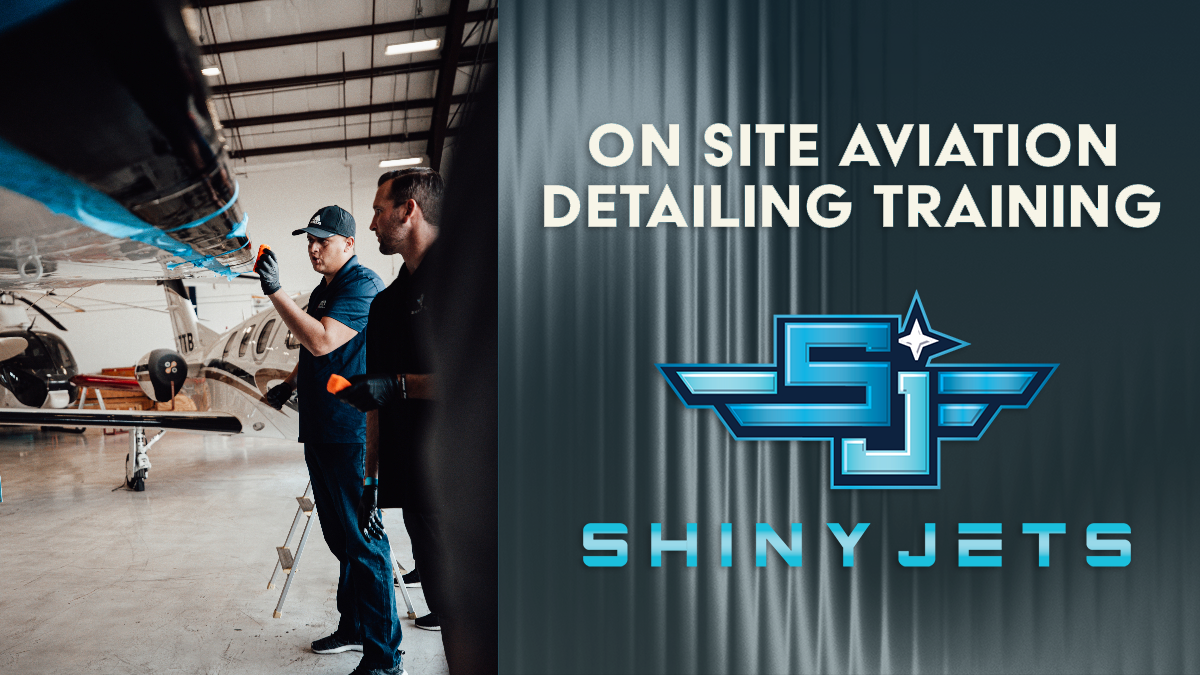
That's why I teach real methods on real aircraft. Pick the format that fits you:
- Online Masterclass ($2,000): self-paced video you can start today. Here's what's inside it.
- 3-Day Certification ($4,995): hands-on at Threshold Aviation, Chino Airport, Chino, CA.
- 5-Day Certification ($6,995 through the Oct 12–16, 2026 class; $7,500 per seat from the Nov 9–13, 2026 class): the full online course plus five days hands-on in Chino.
You can compare all of them on the in-person training page. Every course comes with 12 months of Shiny Jets CRM Business and the Pricing App. Both in-person courses include lunches, snacks and beverages. Hotels aren't included and there's no shuttle; most out-of-town students fly into Ontario (ONT).
Step 2: What insurance do I need to detail aircraft?
Before you buy a single product, call the FBO at your target airport and ask exactly what insurance they require from vendors on the ramp. Every airport is different, so get it in writing.
As a baseline, plan on at least $1 million per occurrence in general liability; many FBOs and operators require more. Work with an aviation-specific broker who understands what FBOs ask for. If you don't have one, Dole and Sons Insurance is a good place to start.
Step 3: How do I get access to the airport ramp?
At most general aviation airports you can work as a mobile detailer with permission from the FBO that manages the ramp. Introduce yourself professionally, show your insurance certificate, and offer to detail one aircraft at a reduced rate so they can see your work. Part 139 commercial airports may require a badge or vendor permit, so check with airport operations.
Step 4: What equipment do I need?
The essentials: a dual-action orbital polisher, an interior extraction machine, a pressure washer with adjustable settings, aircraft-safe wash products and polishes, plenty of microfiber towels and pads, and a safe way to reach the airplane, like an Aerocreeper. Don't use automotive chemicals on aircraft; many of them cause serious damage. For products, I use the Fly Shiny line I developed for aircraft.
How much does it cost to start an aircraft detailing business?
These are typical ranges I see from students starting out, not quotes. Your market and the work you go after will move them.
| Startup item | Typical cost | Notes |
|---|---|---|
| Equipment and starter products | $3,000 to $8,000 | Polisher, extractor, pressure washer, pads, towels, aircraft-safe chemicals |
| Aviation liability insurance | $1,500 to $3,500 per year (typical premium) | At least $1M per occurrence; your FBO may require more |
| Training | $2,000 (Online) · $4,995 (3-Day) · $6,995 / $7,500 (5-Day) | 5-Day is $7,500 per seat from the Nov 9–13, 2026 class |
| Software (quotes, payments, scheduling) | $39.95 to $89.95 per month after a free 30-day trial | Shiny Jets CRM: free 30-day trial, then Lite $39.95/mo or Business $89.95/mo ($899/yr) |
| Website, uniform, vehicle branding | Varies | Start simple: website, Google Business Profile, clean uniform |
Step 5: How should I price aircraft detailing?
Price by labor hours, not flat rates. Underpricing is the biggest mistake I see new detailers make, because aircraft work varies enormously by size, condition and service. A Cessna 172 wash takes 2 to 3 hours. A full detail on a Gulfstream G550 can take 40 to 60 hours. Rates typically run $75 to $200 per hour. Here are common ranges:
| Service | Typical price range |
|---|---|
| Basic exterior wash | $150 to $500 |
| Full detail with paint correction | $800 to $5,000+ |
| Ceramic coating | $2,500 to $8,000+ |
| Brightwork polishing | $500 to $3,000+ per section |
| Interior detail | $300 to $2,000+ |
Shiny Jets CRM is built for aircraft detailers, and the Business plan includes the Aircraft Pricing Tool, which quotes by aircraft make and model so you know your number before you commit. Put your booking link on your website, your social profiles and a QR code on your van so people who see your work can book and pay without a phone call. Every account starts with a free 30-day trial; here's what each plan includes. More on quoting in how to quote aircraft detailing jobs.
Step 6: How do I find my first aircraft detailing clients?
Aircraft owners judge you before you touch their airplane, so look the part: a professional website, a clean uniform, a clean vehicle, a Google Business Profile, and before-and-after photos of your work.
Then start at your local general aviation airport. Walk the ramp, introduce yourself to hangar owners, and leave cards at the FBO front desk. Get involved with your local EAA chapter. Offer one discounted detail to get photos and a testimonial. One happy owner knows dozens of others; referrals drive this industry.
Join the conversation where detailers already are. My Aircraft Detailing 101 group is a good place to read the questions people ask, share what you know and build your reputation.
How do I build recurring revenue?
The best aircraft detailing businesses run on maintenance agreements, not one-off jobs. A monthly wash program at $150 to $400 per aircraft per month creates predictable income: ten aircraft on monthly agreements is $1,500 to $4,000 a month before you book a single one-off job. Build that base first; restoration and ceramic coating jobs are your upside on top of it.
Is aircraft detailing profitable?
It can be. The barrier to entry keeps competition thin in most markets, and owners pay well for professionals they trust. Many of my students recoup their training cost in 2 to 3 jobs, sometimes with a single ceramic coating job, and a 2026 graduate was offered a $120,000-a-year staff job detailing a major tech company's private jets. Your results depend on your market, effort and execution. For real numbers, read how much aircraft detailers make.
Frequently asked questions
What certification do I need to start an aircraft detailing business?
None is legally required. There is no FAA certification or license for aircraft detailers (here's the full breakdown). What FBOs and aircraft owners want is proof you know what you're doing, plus insurance. Hands-on training like the Shiny Jets 5-Day Certification proves your skills on real aircraft.
How much does it cost to start an aircraft detailing business?
From what I see, most people need $3,000 to $8,000 for equipment, plus aviation liability insurance (premiums typically $1,500 to $3,500 a year) and training ($2,000 online up to $7,500 for the 5-Day Certification from November 2026). Shiny Jets CRM starts with a free 30-day trial, no credit card needed, then Lite is $39.95 a month or Business $89.95 a month.
How much insurance do I need to detail aircraft?
Ask the FBO at your airport first and get the requirement in writing. As a baseline, plan on at least $1 million per occurrence in general liability; many FBOs and operators ask for more. Use an aviation-specific insurance broker.
How long does it take to earn back the cost of training?
It depends on your market and how hard you work, but many of my students recoup their training cost in 2 to 3 jobs, sometimes with a single ceramic coating job.
Can I start aircraft detailing part-time?
Yes. A lot of detailers start on weekends at their home airport while they keep a day job. You still need real training and insurance from your very first aircraft.
Do I need my own hangar?
No. Most detailers work mobile on the ramp or in the owner's hangar with permission from the FBO that manages the field.
Ready to start? Book a free call or call me at 858-267-4469, and we'll figure out which path fits you. You can also compare the in-person trainings or read how to become a certified aircraft detailer.
About the author
Brett Berry has spent 15 years in aviation detailing and has cosmetically restored more than 28 warbirds. He founded Shiny Jets, the Fly Shiny product line and Shiny Jets CRM, wrote Beyond Shiny, and has been featured on the cover of InFlight USA. He trains detailers at Threshold Aviation, Chino Airport, 8352 Kimball Ave, Chino, California.

Por Brett Berry

1 comentário
You’ve definitely got my attention. What certifications are required to even be able to detail your first aircraft? Any help would be greatly appreciated.
Thanks
Brenson Jordan
Deixar comentário
Este site é protegido por hCaptcha e a Política de privacidade e os Termos de serviço do hCaptcha se aplicam.