
How to Become a Certified Aircraft Detailer: The Honest 2026 Guide
Updated October 2026 · By Brett Berry, founder of Shiny Jets
You don't need a license to become an aircraft detailer; there is no FAA certificate or government exam. Get hands-on training on real aircraft, earn a skills-verified certification, carry aviation-specific liability insurance, gain ramp access through your local FBO, price by aircraft size and scope, and land your first clients at your home field.
There is no license required to become an aircraft detailer. No FAA certificate, no government exam, no federal registry. We covered exactly what the regulations say here. The real path into this trade is simple to describe and hard to shortcut: learn the craft on real aircraft, get your skills verified, carry aviation-specific insurance, earn your way onto the ramp, and build relationships with the FBOs and owners at your field. That's the whole map. This guide walks it step by step, updated for 2026 and drawn from 15 years on the ramp and the students who fly in from all over the country to train with us at Chino Airport (CNO).
What an aircraft detailer actually does
Aircraft detailing is not car detailing on a bigger canvas. The work spans exterior washing and drying, paint correction and ceramic coatings, brightwork (taken from heavy cut through medium cut to finish polish), interior detailing, de-ice boot care, and polishing acrylic transparencies, which is a discipline of its own. Every one of those surfaces sits on an airframe worth more than most houses, surrounded by pitot tubes, static ports and sensors that can turn a careless pass with a towel into an airworthiness problem.
That's the stakes side. The reward side: aircraft owners and flight departments pay premium rates for people they trust. Full details on business aircraft commonly run $2,500 to $5,500 per aircraft depending on size and scope, and the field is nowhere near as crowded as automotive. This trade rewards exactly two things, skill and trust, and every step below builds one or both.
Step 1: Understand what "certified" actually means
Here's the honest version most programs won't lead with: every aircraft detailing certification in this industry, including ours, is a private credential. No government agency recognizes any of them. A certificate is worth exactly what the training behind it is worth, and what the name signing it means to the FBO manager reading it. We wrote the full breakdown in Is There an FAA-Approved Aircraft Detailing Certification? Read it before you pay anyone, because a program claiming to be "FAA-approved" or "the only recognized certification" has already told you something untrue.
So why get certified at all? Because the gatekeepers of this business (FBOs, insurers, chief pilots, owners) need a reason to trust you before you put a machine anywhere near their paint. Verified training is that reason. It just has to be real.
Step 2: Get trained on real aircraft
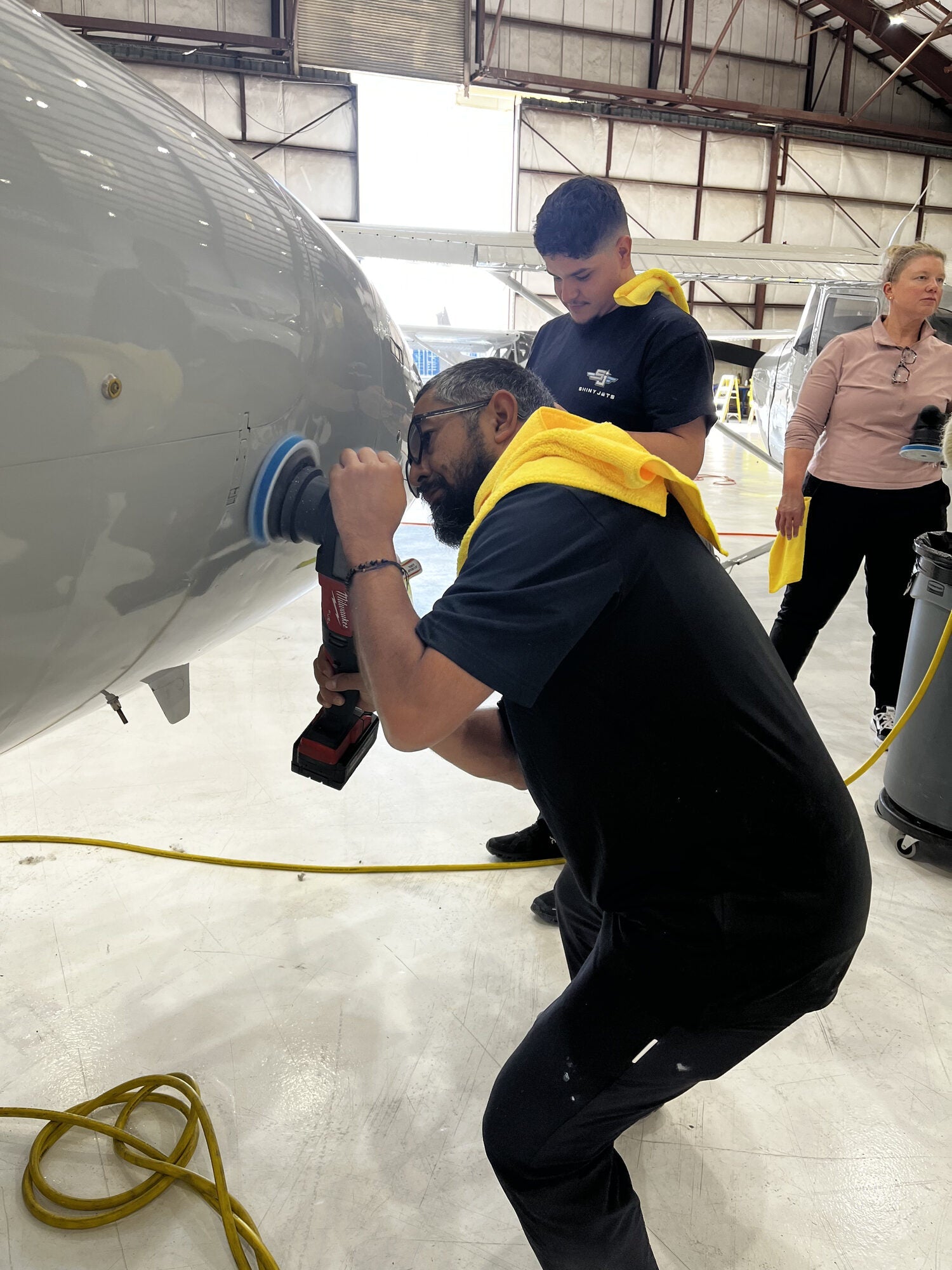
You cannot learn aircraft detailing from YouTube. The difference between a great detail and a $40,000 paint correction mistake comes down to muscle memory, product feel and reading a surface. Those only build with hours on real airframes under someone who has already made every mistake for you.
What real training looks like: hands-on hours at an actual airport, station-by-station skill sign-offs before any certificate is issued, methods grounded in manufacturer guidance, and a safety culture that treats taped transparencies, covered ports and ladder discipline as non-negotiable. It also builds judgment: knowing when a maintenance manual line is a hard requirement and when it's a recommendation that professional experience can meet a better way. That judgment is the craft.

At Shiny Jets we run two hands-on paths to the same station-verified certification, plus an online course for those who need to start from home:
| Program | Price | Format | Best for |
|---|---|---|---|
| 3-Day Certification | $4,995 | Friday–Sunday, hands-on at Threshold Aviation, Chino Airport, 10 seats | Working detailers who need aviation skills and certification without missing a work week |
| 5-Day Masterclass | $7,500 starting with the November class ($6,995 through the October class) | Monday–Friday, hands-on at Threshold Aviation, Chino Airport, plus the lifetime online course and 4 business setup sessions | Starting from zero and building the full business. Lunches, snacks and beverages included; hotel not included. |
| Online Masterclass | $2,000 | Self-paced, about 7 hours of video, printable certificate | Learning the fundamentals from home before hands-on training |
Whether you train with us or anyone else, vet the program hard. Here are the ten questions to ask before you pay. Every Shiny Jets training also comes with our library of standard operating procedures, because the goal isn't a weekend memory; it's a repeatable standard.
Step 3: Get insured before your first paid job
Certification without insurance is a loaded gun. Aviation-specific liability coverage is what lets you touch a customer's aircraft with everyone breathing normally, and it's the first document an FBO will ask for, usually before they ask about your skills. General auto-detailing policies don't cover airframes; you need a broker who works aviation. We walk students through carriers and real coverage costs during the program, and referrals to aviation-specific insurance brokers come with certification.
Step 4: Earn your way onto the ramp
Airport access is controlled, and that's a feature of this business, not a bug: it keeps the field small. At most general aviation airports you'll start under escort or through an FBO's vendor process; commercial fields add badging and background checks. Show up insured, professional and disciplined about FOD and safety, and the same gates that keep amateurs out become the moat around your business.
Step 5: Price like aviation, not like automotive
The number-one mistake new aircraft detailers make is dragging car-wash pricing onto the ramp. Aircraft detailing is a premium trade for a premium clientele: price by aircraft size and scope, quote brightwork by the step, not by the job, and never apologize for professional rates. The owner's alternative is untrained hands on a multi-million-dollar airframe. For a grounded look at what working detailers actually bring in, we published real income numbers here.
Step 6: Land your first three clients
Start at your own field. Walk into the FBO, meet the manager, and ask who takes care of the aircraft. Chances are the answer is "nobody, consistently." Do the first jobs at full standard, photograph the before and after, and let the results travel hangar to hangar; this industry runs on word of mouth between chief pilots. Shiny Jets graduates are also listed in the certified detailer directory that owners and FBO operators search, which is how many land work in their first month.
Many of our students recoup their training cost in 2–3 jobs, sometimes with a single ceramic coating job. And your own business isn't the only path: in 2026, one Shiny Jets graduate was offered a $120,000-a-year staff position detailing a major tech company's private jets.
Step 7: Survive year one
Training gets you in the door; standards keep you there. The graduates who fail aren't the ones who lack talent. They're the ones who drift from their SOPs when nobody's watching, underquote until the math breaks, or stop learning after the certificate. We wrote honestly about why most aircraft detailing graduates fail in their first year so you can be the exception. The craft behind this program (15 years of it, from light singles to warbird restorations) is also in the book Beyond Shiny if you want the philosophy underneath the procedures.

Frequently asked questions
Do you need a license to become an aircraft detailer?
No. There is no FAA license or government certification for aircraft detailing (full breakdown here). In practice, FBOs and insurers require proof of training and coverage, which is why verified certification matters commercially even though it isn't required legally.
How long does it take to become a certified aircraft detailer?
Hands-on certification takes 3 to 5 days. The self-paced Online Masterclass is about 7 hours of video that you watch at your own pace. Building a full book of business typically takes a few months of consistent work at your local field.
How much does aircraft detailing training cost?
Serious hands-on programs run in the four figures. The Shiny Jets 3-Day Certification is $4,995, and the 5-Day Masterclass is $7,500 starting with the November 2026 class ($6,995 through the October class). The Online Masterclass is $2,000. Many students recoup their training cost in 2–3 jobs, sometimes with a single ceramic coating job.
Can you start aircraft detailing part-time?
Yes. Many of our graduates start with weekends at their local airport while keeping their day job. You still need aviation-specific insurance and proper training from day one; the aircraft doesn't know you're part-time.
Do FBOs require certification?
Not by law; no certification is legally required. In practice, most FBOs and flight departments require proof of insurance and want evidence of formal training before granting vendor access, so a verified credential is usually the difference between a callback and a no.
Ready to start? Book a free call and we'll map your path honestly, even if it isn't with us, or compare the in-person trainings.
About the author
Brett Berry has spent 15 years in aviation detailing and has cosmetically restored more than 28 warbirds. He founded Shiny Jets, the Fly Shiny product line and Shiny Jets CRM, wrote Beyond Shiny, and has been featured on the cover of InFlight USA. He trains detailers at Threshold Aviation, Chino Airport (CNO), Chino, California.

Written by Brett Berry

Leave a comment
This site is protected by hCaptcha and the hCaptcha Privacy Policy and Terms of Service apply.